Start With the Thing You Can Verify
Sidewall size, tread depth, pressure reading, axle position, and visible damage are better starting points than guesses about what “usually works.”
Independent tire reference
TruckTireGuide.com helps drivers, owner-operators, small fleets, dispatchers, and maintenance staff check tire sizes, load ratings, pressure habits, wear patterns, DOT date codes, inspections, retreads, and tire costs.
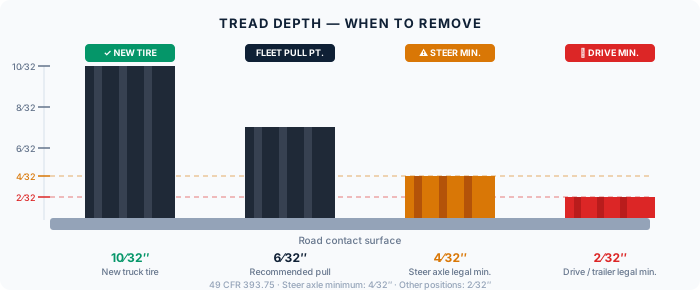
Sidewall size, tread depth, pressure reading, axle position, and visible damage are better starting points than guesses about what “usually works.”
The calculators help with planning and rough checks. They do not replace manufacturer tables, scale weights, fleet policy, or professional tire inspection.
Safety and compliance pages include source notes so unclear claims can be traced back to government, manufacturer, industry, or editorial references.
Start here when a sidewall size, wheel diameter, or low-profile substitution needs a second look before ordering tires.
Use this section when the question is not “what size fits?” but “can this tire carry the actual axle load in this position?”
Pressure decisions should begin with tire data and axle load, not a number copied from another truck.
Wear patterns are clues. Name the specific pattern first — then check the pressure, load, alignment, suspension, or wheel-end issue behind it. Rotation is a tool for managing wear, not a fix for mechanical causes.
Inspection pages are written for practical walk-arounds and maintenance records, with conservative source notes for safety and compliance topics.
Retread decisions depend on casing quality, application, inspection, retreader process, and the positions allowed by policy.
Cost per mile is a more reliable comparison metric than purchase price alone. A cheaper tire that wears faster or fails earlier often costs more per mile than a more expensive one that reaches full removal depth. This browser-only calculator does not store or transmit your numbers.
Build a rough replacement budget before you get to the shop. Prices vary by brand, casing program, region, and service provider — this estimate is a starting point for conversation, not a final invoice. The calculator runs in your browser and does not send your numbers anywhere.
Wear rate is a planning tool, not a guarantee. A tire that is wearing at an irregular rate — faster on one shoulder, faster on the center — needs inspection and cause investigation before the projected mileage estimate has any value. This calculator runs in your browser and does not transmit your data.
This is a rough screen — not a load approval. The checker divides axle load equally among tires, which is a simplification. Side-to-side load distribution, single versus dual ratings, GAWR, wheel ratings, and the required inflation pressure from the manufacturer's table all require separate verification. The tool runs in your browser and does not send data anywhere.
A consistent inspection route reduces the chance of missing a tire. The checklist gives inspection steps and a structured sequence — it does not produce PSI targets. Exact inflation pressure depends on the specific tire, axle load, and manufacturer's load and inflation table. This tool runs in your browser and does not store your inputs.