Recap and Retread Tires
Recap Tires Explained
A recap tire is not just a cheap tire, and it is not automatically a bad tire. It is a casing that has gone through a retread process and then returns to service under an application policy.
The important questions are casing quality, retreader process, position, inspection, and fleet rules.
A retread program works best when the casing is treated as an asset with a history, not as scrap rubber that happens to get another tread.
Basic idea
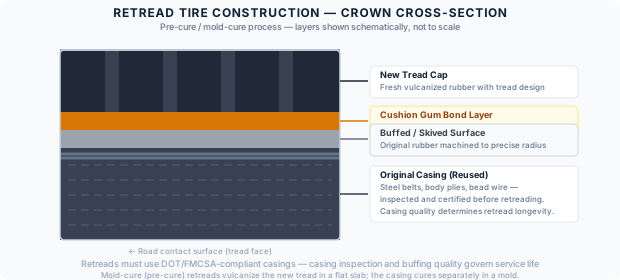
Retreading keeps a suitable casing in service by applying new tread through a controlled process. The most common modern method is pre-cure retreading, where a pre-molded tread band is bonded to the buffed casing through a vulcanization process. Mold cure retreading builds and cures the tread in a mold around the casing. Suitability for retreading depends on inspection, casing history, repairs, and the retreader's acceptance criteria.
How to identify a retread tire
Federal regulations require retreaded tires to be marked on the sidewall with the word "RETREAD" or "RECAPPED." A faint seam or ridge at the tread-to-sidewall junction is also sometimes visible where the new tread was bonded to the existing casing. The DOT TIN on a retreaded tire should reflect the retreader's identification and the date of retreading.
Inspection points unique to retreads
- Look closely at both shoulders where the new tread meets the original casing.
- Check for edge lifting, bubbles, soft spots, or a hollow sound when the tread is tapped.
- Review casing history when available: prior repairs, previous retread cycles, and any run-flat record.
- Confirm the tire is being used in a position allowed by fleet policy and retreader guidance.
- Treat repeated pressure loss as a casing-risk issue, not only a valve or puncture issue.
Where the decision belongs
- Fleet maintenance policy and approved position list
- Retreader documentation and acceptance criteria
- Tire and vehicle manufacturer guidance
- Application and axle position
- Driver inspection habits
What a small fleet should write down
A retread program does not need complicated software to start, but it does need a few consistent notes. Record the casing source, axle position, installation date, tread pattern, removal mileage, removal reason, and whether the casing was accepted for another cycle.
Without those notes, the fleet only knows the purchase price. It will not know whether the tire was removed for normal wear, pressure damage, impact, separation warning, or a route that was wrong for the tread design.
When a recap is the wrong conversation
If the casing history is unknown, the tire has repeated pressure loss, or the position has already produced separation warnings, the question should not be "recap or new" yet. First decide whether the casing is suitable for any continued service.
A low-price retread on a weak casing is not a retread program; it is a deferred failure. The retreader inspection and the fleet position policy are the guardrails.
Retread Review Checklist
- Inspect casing and sidewall condition.
- Check retread markings if present.
- Inspect both shoulder edges.
- Follow fleet position restrictions.
- Track removal reason and casing outcome.
- Remove tires with separations, bulges, or suspicious repairs.
FAQ
Are retread tires legal on commercial semi trucks?
Retreaded tires are legal for use on commercial vehicles at most axle positions. Federal regulations do not prohibit retreads on drive or trailer axles for most vehicle types. Restrictions vary by vehicle class, operating conditions, and state rules. Fleet policies and customer contracts may impose stricter limits than the minimum required by law. Always verify current rules and your carrier policy for the specific application.
How are retread tires made?
In pre-cure retreading — the most common modern process — a used casing is inspected for suitability, buffed to a precise profile, any damage is repaired according to retreader standards, and a pre-molded tread band is bonded to the casing through vulcanization. In mold-cure retreading, uncured rubber is applied to the casing and cured in a mold. The retreader controls tread compound, pattern, and curing process quality. Casing condition and prior history are evaluated before acceptance.
What is a casing credit and why does it matter?
A casing credit is a value assigned to a used tire casing that a retreader or tire supplier may apply toward a retread or replacement purchase. The credit depends on the casing's condition, size, brand, and whether it meets the retreader's acceptance standards. A casing run to failure, operated severely underinflated, or damaged by a road hazard typically has little or no casing credit value. Protecting casing value through proper inflation and timely removal is part of what makes retread programs economical.
Source Notes
- Government NHTSA interpretation on retreaded truck tires
- Industry A Beginner’s Guide to Retreading
- Site note TruckTireGuide.com editorial notes
Editorial Review
TruckTireGuide.com editorial team
Maintained by an independent editor with fleet tire-program experience in regional Class 8 operations, supported by transportation regulatory research and commercial vehicle technical writing.
Pages are checked against public regulations, manufacturer resources, industry references, and conservative field practice. The site does not approve tires for service or replace qualified inspection.